Reshaping Evidence: How Can We Better Understand Systems Change?
# Measuring Holistic Outcomes
# Accelerating Systems Change
Exploring how lasting improvement in education happens by building an evidence base that captures not only what works, but also how and why it works across diverse contexts
April 21, 2026
Sushmita Subedi

Jean Arkedis

Alex Beard
Reshaping Evidence: How Can We Better Understand Systems Change?
A New Learning JourneyAcross the global education community, a deeper question is taking shape alongside the work of improving learning outcomes: How do we understand the conditions that make improvement possible and lasting? How do we build an evidence base that can hold both what works and how and why it works across diverse and complex contexts?
As part of the Global Institute's agenda to foster continuous growth among those reshaping education, this blog series creates a space to explore those questions together. It brings together researchers, policymakers, and partners—independent, locally led organizations across Teach For All's global network —to share what we are learning, sit honestly with the tensions, and build a more expansive evidence agenda for systems change. Join us in this learning journey and share your reflections, insights, and stories from the field. |
Something remarkable is happening in education globally.
In the Andean region of Áncash, Peru, the Efecto Áncash initiative united communities not around a single program, but around a shared purpose. This collaborative effort—spearheaded by Enseña Perú alongside industry partners Antamina, Wheaton Precious Metals, and Franco-Nevada—worked in close coordination with the Regional Education Office and Local Education Management Units (UGEL) to bring together educators, principals, parents, and community members. Educators met regularly to reflect on their practice. Families were invited in as partners in problem-solving. Students' reading and math scores improved significantly , with the boost in student learning from this initiative much larger than what is typically seen from other educational interventions.
In London, a city-wide coalition held together across seven years and multiple political cycles, united by one aspiration: to make London the best city in the UK to go to school, especially for its most disadvantaged students. Communities of practice built the trust and shared knowledge that kept reform alive over time. Teach First 's mission-driven teachers brought new energy and leadership into schools. The share of students achieving strong grades rose from 35% to over 60% , and the gap between advantaged and disadvantaged students narrowed more than anywhere else in England.
In Pune, India, a network of dedicated educators and local leaders have built a movement that resembles a thriving garden: many different efforts growing together, each one rooted in the same soil. They are united by a shared purpose: transforming the life paths of children from some of the city’s most struggling communities. These efforts include early childhood programs, community centers, after-school learning spaces, coding initiatives, arts programs, and iTeach Schools, which provides long-term support to help under-resourced students navigate successfully from school through college and career. What made this possible was years of tending that soil: building relationships, deepening trust, and creating the conditions in which each new effort could take root and grow. Today, over 90% of iTeach's graduates enroll in college , and 85% of the program’s earliest graduates are employed or pursuing postgraduate degrees.
This is one of the core insights of regenerative agriculture: strong yields and healthy soil depend on each other. What grows above the surface is only as strong as what is nurtured beneath it. This wisdom has lived in classrooms, schools, and communities for generations. What is emerging now is a broader recognition that how we study and measure change needs to go deeper to understand what makes that growth possible.
What is making this difference?
When we ask the people closest to this work, the answer rarely begins with a program. It begins with the relationships that formed over time: a teacher who chose to stay rooted in a community, an educator who came back and started convening people who had never worked together before, a coalition that held together even when it was hard to, and a community that slowly began to believe something different was possible for its children and acted on that belief.
If these are the kinds of changes happening across the global education community, two questions follow naturally: What kind of evidence would we need to understand them deeply and learn from them? And does our current evidence base do justice to these efforts?
Two ways of seeing change
At the heart of these questions is a tension that has run through education research and practice for decades. It is a tension between two different ways of understanding how change happens.
The first is a rational worldview. It asks: What works? It looks for programs and interventions that produce measurable improvements in learning outcomes, tests them rigorously, and seeks to scale what the evidence supports. This worldview has given us randomized controlled trials, global learning assessments, and a rich body of knowledge about effective instructional practices. It has helped to produce important gains, particularly in systems with the institutional capacity to adopt and implement evidence-based approaches well.
The second is a relational worldview. It asks: What conditions allow things to work? It looks at the trust between teachers and families, the shared purpose that holds a coalition together, the culture of a school that makes teachers want to stay, and the sense of agency in a community that makes change feel possible. This worldview recognizes that the same program can transform learning in one context and dissolve quietly in another, and that understanding why requires paying close attention to the human dynamics beneath the surface.
Some of the most powerful education transformations we have seen in our own network, in Áncash, in London, in Pune, have drawn on both, combining strong instructional practices and good program design with deep investment in relationships, purpose, and collective learning. And they are far from alone. Across the world, in contexts as different as rural Colombia, urban South Africa, and community schools in Southeast Asia, the rational and the relational have worked together to produce change that neither could achieve on its own.
What does this mean for how we think about evidence?
The question this series explores is how our evidence base can expand to hold both. Decades of investment in rigorous tools for measuring what works, through experimental evaluations, learning assessments, and performance data, has produced valuable knowledge that we want to build on. At the same time, developing methods to rigorously and consistently document and measure the relational dimensions of change, such as trust, shared purpose, and adaptive capacity, is a frontier that has been deeply under-resourced. Building the evidence base to hold both dimensions together is one of the most important and generative challenges in education research today.
The RISE Programme (Research on Improving Systems of Education) offers a useful window into this challenge. Despite historic gains in enrollment, the quality of learning measured as the literacy rate of adults with a given level of schooling, was stagnant or declining across most developing countries between 1960 and 2000. Across 88 countries, more schooling was producing less learning per year spent in school. Their research points to one reason why: education systems are often not truly organized around learning as their central goal. Teachers, administrators, officials, and communities can end up responding to different pressures and different ideas of what success looks like, making it harder for even well-designed programs to take root and endure.
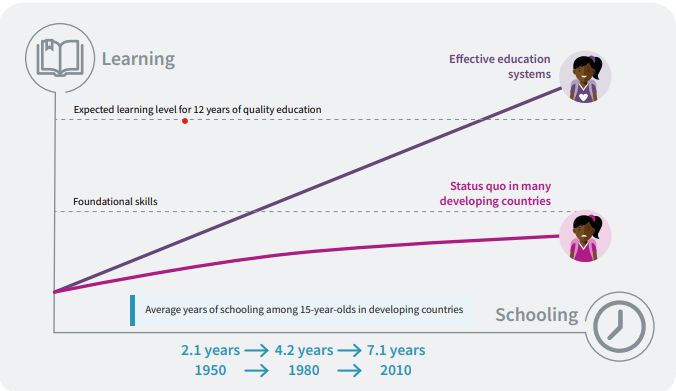
This finding raises an important question for evidence. If the conditions within a system shape whether change takes root, then measuring programs and their outputs alone will only ever tell part of the story. Understanding what enables those programs to work, and what gets in the way, is just as important as understanding whether they work. The evidence agenda needs to be wide enough to hold both questions at once.
What our partners are seeing, and the evidence agenda this moment calls for
When we ask Teach For All partners—independent, locally led organizations across our global network—what they report to donors and external audiences, we often hear a familiar list: enrollment numbers, training hours, assessments completed. When we ask them what they actually believe and see is changing, the conversation opens up new layers of insight that we are only beginning to find ways to understand.
These are the kinds of conditions that the RISE Programme's research points to as shaping whether change takes root: the trust, shared purpose, and collective learning that we have seen at work in Áncash, in London, and in Pune. Our partners are already navigating this terrain. What we want to build is a deeper understanding of how these conditions form, how they interact with program design and instructional practice, and how they shape outcomes over time.
That is the evidence agenda this moment calls for: an expansion of rigorous inquiry. We need stronger theory, grounded in the lived experience of educators, communities, and systems, to better understand how and why change happens. We need richer ways of observing, measuring, and learning about the relational and adaptive dimensions of change alongside the technical ones. And we need better approaches to researching efforts that combine both, so we can understand not only whether they work, but how they work in practice, and what makes the difference across different contexts.
Research and measurement tools in education have grown significantly in their ability to track outputs and identify effective programs at scale: test scores, graduation rates, program uptake. These measures serve an important purpose for accountability and comparative understanding. Alongside them, we are also asking how to build the evidence base to understand the relational and adaptive dimensions of change with rigor and consistency. Both sets of questions matter, and learning how to pursue them together is at the heart of what this series is about.
An invitation to learn together
This blog series starts from a shared recognition. Across our network, partners have been sensing their systems and responding thoughtfully to what they find for years. The next step is to build an evidence base that honors those practices, one that can hold complexity, learn from it, and strengthen how we understand change across contexts.
That means making the learning happening across our network visible, rigorous, and cumulative, so that insights from a community in Pune connect with lessons from a network in Áncash, and both deepen how we think about systems change globally. It means designing research with the people closest to the work, so that evidence reflects the full texture of what is shifting in a system.
This series will hold these tensions honestly and ask hard questions: Who gets to define success, whose knowledge counts, and what becomes possible when communities and practitioners shape the inquiry alongside researchers.
And it will celebrate what is already working, treating the wisdom that partners have built through years of relational, trust-building, adaptive work as a vital source of knowledge, and investing in the shared frameworks we need to make that wisdom visible and cumulative.
The Áncash story, the London story, and the Pune story point toward what becomes possible when our evidence base evolves alongside our theory of change. The opportunity now is to build the evidence base that enables us to learn from these efforts, grow with them, and help the insights travel across contexts.
We think the most powerful way to do that is together, and we invite you on this learning journey.
Comments (0)
Popular

Dive in
Related
Video
Gaby, Greysson & Eivind: Learning to Transform Systems | 2026 Better Future Showcase
Jul 21st, 2026 • Views 43
Video
Stella Rose Akongo: Building Systems That Model Agency | 2026 Better Future Showcase
Jul 21st, 2026 • Views 21
Video
Ng Aik Yang: Redesigning Our Systems of Feedback | 2026 Better Future Showcase
Jul 21st, 2026 • Views 22
Video
Gaby, Greysson & Eivind: Learning to Transform Systems | 2026 Better Future Showcase
Jul 21st, 2026 • Views 43
Video
Ng Aik Yang: Redesigning Our Systems of Feedback | 2026 Better Future Showcase
Jul 21st, 2026 • Views 22
Video
Stella Rose Akongo: Building Systems That Model Agency | 2026 Better Future Showcase
Jul 21st, 2026 • Views 21