
What 35 Years Have Taught Me About Transforming Education
# Developing Teachers & Leaders
Transforming education requires collective leadership and reimagined classrooms.
November 9, 2026
Wendy Kopp
By Wendy Kopp
A little more than 35 years ago, as I approached graduation from Princeton, I was searching for what I would do. The banks and consulting firms were aggressively recruiting liberal arts students like myself. We were described as the “Me Generation”—ambitious, materially minded young people who were concerned only with taking care of ourselves.
I was studying public policy and was searching for something that would enable me to make a real difference in our country, and I thought that I wasn’t alone—that, in fact, many of us soon-to-be graduates were searching for a purposeful next step. As I reflected, I realized that education had given me my freedom and was in some ways the most fundamental issue of all—and one day, a question dawned on me that I just couldn’t let go: Why weren’t we being recruited to commit two years to teach in urban and rural schools as aggressively as we were being recruited to commit two years to work on Wall Street?
It was my final year. I needed a thesis topic, so I began researching the policy environment in which a national teacher corps would operate, as well as historical models of similar service corps.
The day after I submitted the thesis, I turned it into a proposal and began searching for a seed grant to start Teach For America. I reached out to school districts, teacher educators, national education leaders, and prospective funders. Most agreed that the need was immense and the idea compelling. But nearly all doubted that students at the most selective public and private universities in the country would sign up for this.
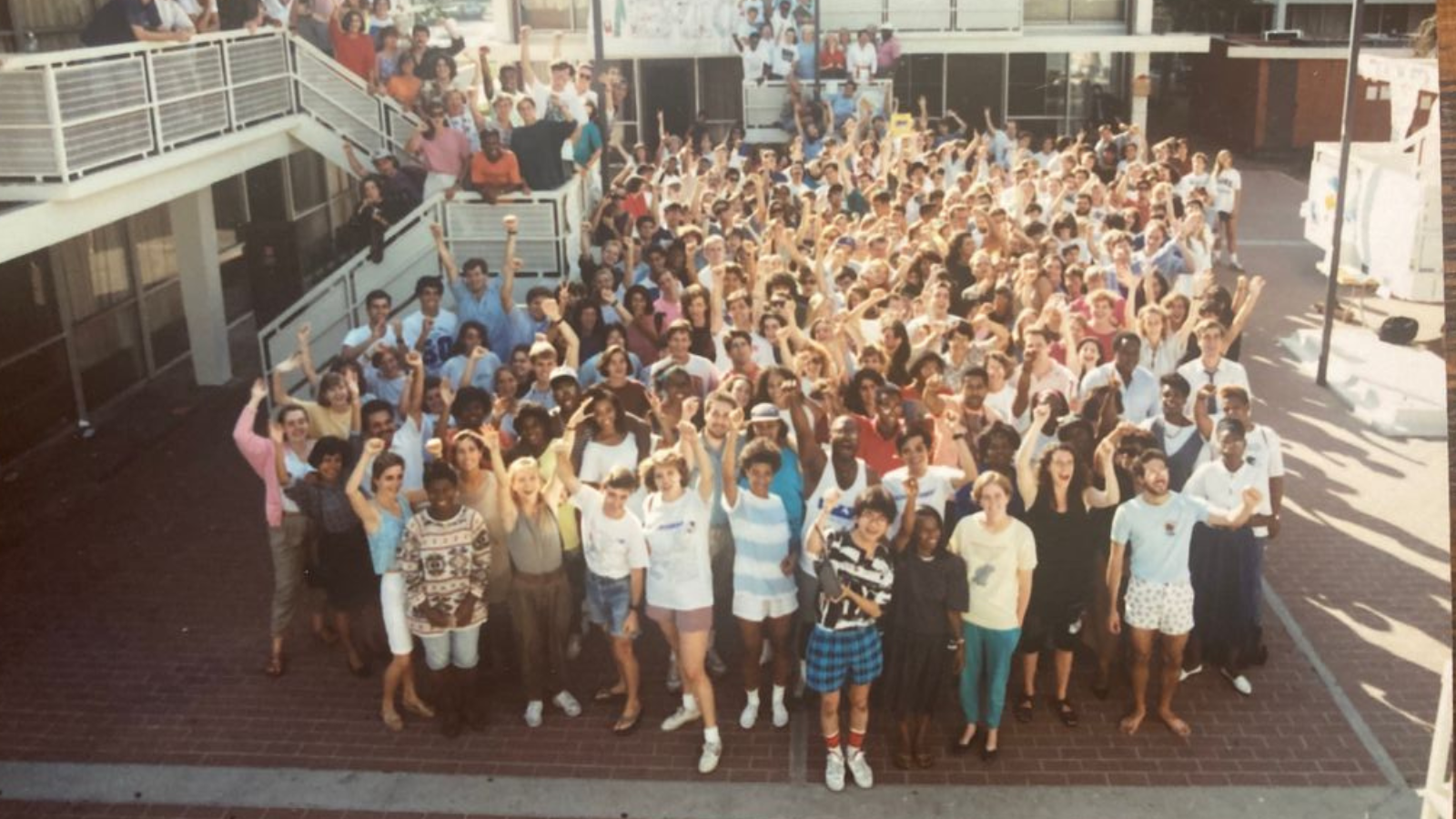
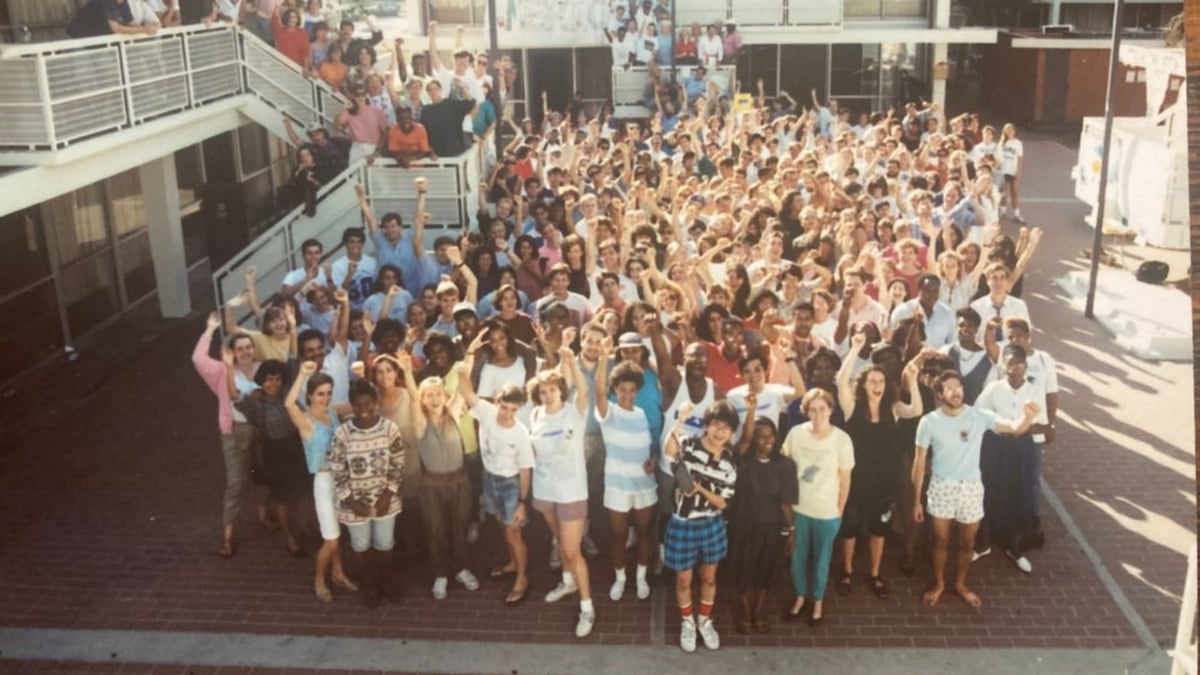
Inaugural Teach For America corps members in Los Angeles, 1990.
Within three months, 2,500 young Americans had applied. Since then, more than 70,000 have joined Teach For America, and 60,000 more have gone through similar programs across the Teach For All network in more than 60 countries. For most of them, what began as a two-year teaching commitment became a lifelong one—about 75 percent of the alumni of these two-year teaching commitments go on to devote their careers to tackling systemic challenges faced by children, and they’ve become school leaders, policymakers, social entrepreneurs, and community organizers. Over the years, I have learned from and alongside these incredible people working to transform education in the United States and all over the world.
Globally, systems are too often failing to develop the holistic qualities that young people need to shape a better future in today’s world—the agency, awareness, wellbeing, connectedness, expertise, and sense of purpose they need to shape their own lives and contribute to the world around them. Our schools also frequently fail to deliver even a satisfactory basic education, with hundreds of millions of children worldwide in school but not learning and global levels of education declining over the past decade, especially among disadvantaged children. According to the World Bank, 7 in 10 children in low- and middle-income countries cannot read a simple text with comprehension by age 10. In the United States, nearly 7 in 10 fourth graders scored below NAEP’s Proficient level in reading in 2024.
Over these decades, I’ve had the chance to spend time in classrooms and communities where something very different is happening—where students are making real progress academically and developing holistically, often in the very places where the systems around them are not set up to enable this. What they’ve shown me is that the answer isn’t to do what we’ve always done, only harder. It’s to rethink what we want education to accomplish, what happens in our classrooms, and how we work together to change whole systems.
Looking back, three lessons stand out most.
Lesson 1: Everything starts with considering what we want for our communities, our countries, and our global society
After completing Teach For America in 2010, Larisa Hovannisian returned to her home country, Armenia, which declared its independence from the Soviet Union in 1991. Its deepest legacy, she believes, is that it “destroyed people’s belief that they could ask questions,” or that they had the ability to decide something for themselves. For Larisa, founding Teach For Armenia was a nation-building endeavor—an opportunity for people to recover the agency to shape their communities and country. It began with a co-creative process they call the Kochari, after an Armenian dance in which people hold hands, face one another, and move together. They asked communities what they believed should be true for their children. And that process of inquiry alone “ignited people’s recognition that they have an answer to provide.” It was almost as though people had been waiting for permission—and through this process, they began to recognize that no one had to give it to them.
This process led Teach For Armenia to a promise for 2050: by the time today’s children are 25 years old, the country will have been reshaped and reimagined by them and through their leadership. That promise changed everything—from how they selected teachers to how they trained and supported them. They needed teachers who themselves demonstrated a strong sense of agency and leadership, and could cultivate those qualities in others. The promise meant classrooms would need to center students’ leadership development rather than treating them as passive receptacles of information.
Larisa’s work has stayed with me because its lesson applies everywhere, including in my own country. What do we want to be true for our communities and countries—and what does that mean for our classrooms and schools?
What we believe education is for shapes what schools value, the outcomes they pursue, the teachers they develop, the experiences students have each day—and even how we prioritize education. In this sense, classrooms are where societies continually recreate themselves. What young people learn in classrooms about exercising agency, relating across differences, and responding to the challenges around them eventually finds expression in our institutions, our politics, and our relationships with one another. This creates such an opportunity, and such an imperative and responsibility for our educators.
Lesson 2: To develop students as leaders who can shape a better future, we need to change a lot about our classrooms
So if we want young people who can shape a better future, what needs to change about what they experience in our classrooms?
Steven Farr has spent much of the past three decades devoted to studying what differentiates the most successful teachers. In the late 1990s and early 2000s, he and others at Teach For America studied classrooms in pursuit of a guiding question: What are teachers doing in classrooms where students are achieving academically at exceptional levels? The patterns they found became Teaching as Leadership, a framework that influenced the preparation of thousands of Teach For America corps members.
Years later, Steven led a new round of studies across the Teach For All network. This time, we pursued a different question: What is happening in classrooms where students are developing outsized academic outcomes and other important qualities, such as a sense of agency and commitment to improving our collective welfare? More than 6,500 students, teachers, families, and community members from dozens of countries participated as co-investigators, virtually visiting classrooms all over the world that local organizations identified as transformational in students’ lives. From those virtual visits, four patterns emerged.
The first is purpose. In every one of these classrooms, teachers are oriented not towards curricular objectives alone but towards the purpose of developing students who can shape a better future, for themselves and for all of us—just as Larisa and her colleagues were in Armenia.
The second is what Steven describes as teachers’ “lenses”—how they shift from seeing their students as passive receivers of knowledge to seeing them as leaders today; from seeing themselves as the source of knowledge to seeing themselves as learners; from seeing their communities as full of challenges to seeing them as sources of wisdom and assets; and from seeing their students’ struggles as something to fix to seeing those struggles as a reflection of the system around them and something to work on together.
Third, these shifts in perspective make possible a different model of teaching and learning. These classrooms are more relational and more student-centered. Students lead learning and learn from one another. The teacher is a guide and coach to the students in their own journey, not the source of all knowledge and wisdom in the room.
And fourth, these classrooms value a broader set of outcomes than our education systems have been designed around. When co-investigators asked what these classrooms value—not what a ministry or a head of school asks them to report—what came up all around the world would fit in six families of outcomes: purpose, wellbeing, connectedness, awareness, agency, and expertise. In these classrooms, students get to reading, writing, and math through student agency, instead of at the expense of student agency.
Steven believes that what we’re learning from these classrooms is “the greatest hope we have for humanity’s future.” Our inherited education systems largely prepare individuals to compete within the world as it exists. But the defining challenges of our time require people who can think critically, create across disciplines, exercise judgment, and lead with others. These classrooms are oriented not to preparing students to escape today’s challenges for their own welfare, but to solving them in order to improve our collective welfare.
Lesson 3: It will take all of us, working together with shared purpose, to realize our vision
But how do we make classrooms like these the norm—not just in a few places, but in whole communities and whole countries? How do we realize our vision of the day when all children have the education, support, and opportunity to shape a better future for themselves and all of us?
This may seem obvious, but too often we approach education as if a single program, policy, or leader could change things on their own. But what I’ve seen is that sustained transformation requires people throughout a system to share a purpose and vision for where they want to take that system, and to stay connected closely enough to learn and act together. In short, we need collective leadership.
Tomás Recart began his career as an engineer in Chile and never imagined he would work in education. But his first job took him into one of the lowest-income communities in his city, and over five years he came to see that software was necessary, but insufficient; better curriculum was necessary, but insufficient; and public policy was necessary, but insufficient.
Chile is one of the world’s most seismically active countries, experiencing an average of 8,300 tremors a year. Chileans feel the earth moving all the time, and in some ways it has become normal. But when a serious earthquake hits, everyone knows what the moment demands: people get off the couch and act together to dig out survivors from the rubble. “Why don’t we do the same with schools?” Tomás asks. “Why don't the normalized failures in our education system provoke that same collective urgency?”
That question led him to found Enseña Chile. What he has learned since is that people and relationships are everything. Enseña Chile’s alumni are now working throughout the system, and they keep coming back to one another—82 percent say they meet another alum at least once a month. They describe their experience as a series of “necessary but improbable encounters” with people they would never otherwise have met. “It is not enough to just develop individual leaders,” Tomás says. “We have to create the relationships that allow people to keep learning from one another, working together, and staying connected to the challenge over time.”
When I think about why kids have more opportunity in some places today—from Mississippi in the U.S, to Ancash, Peru, to Ogun State, Nigeria, to Pune, India—it’s because enough people in those places are on an all-out campaign to make it happen. It’s hard. It takes time. But I’ve seen that with enough leadership, we can change anything. The pressures of short-term political cycles and media attention push for quick, easily attributable, and infinitely scalable results, but real change in education doesn’t work that way. It takes all of us keeping our foot on the pedal, recruiting the next generation into this work, and picking ourselves and each other up after each setback.
The young people in our classrooms today will be shaping our world before we know it. They are coming of age amid artificial intelligence, environmental instability, polarization, and widening inequality, and before long they will be leading our institutions, designing our technologies, and deciding whether our differences become sources of creativity or division.
We can keep putting bandaids on our problems—and, of course, we must. But our best chance of putting our world on a different trajectory is to transform our education systems so that all young people develop as leaders who are committed to peace, justice, and sustainability, and who have the agency, awareness, connectedness, wellbeing, and expertise to make it happen. We know this is possible. And we know it will only happen with a whole lot of leadership and a whole lot of learning among those leaders about how to reshape our classrooms, schools, and systems.
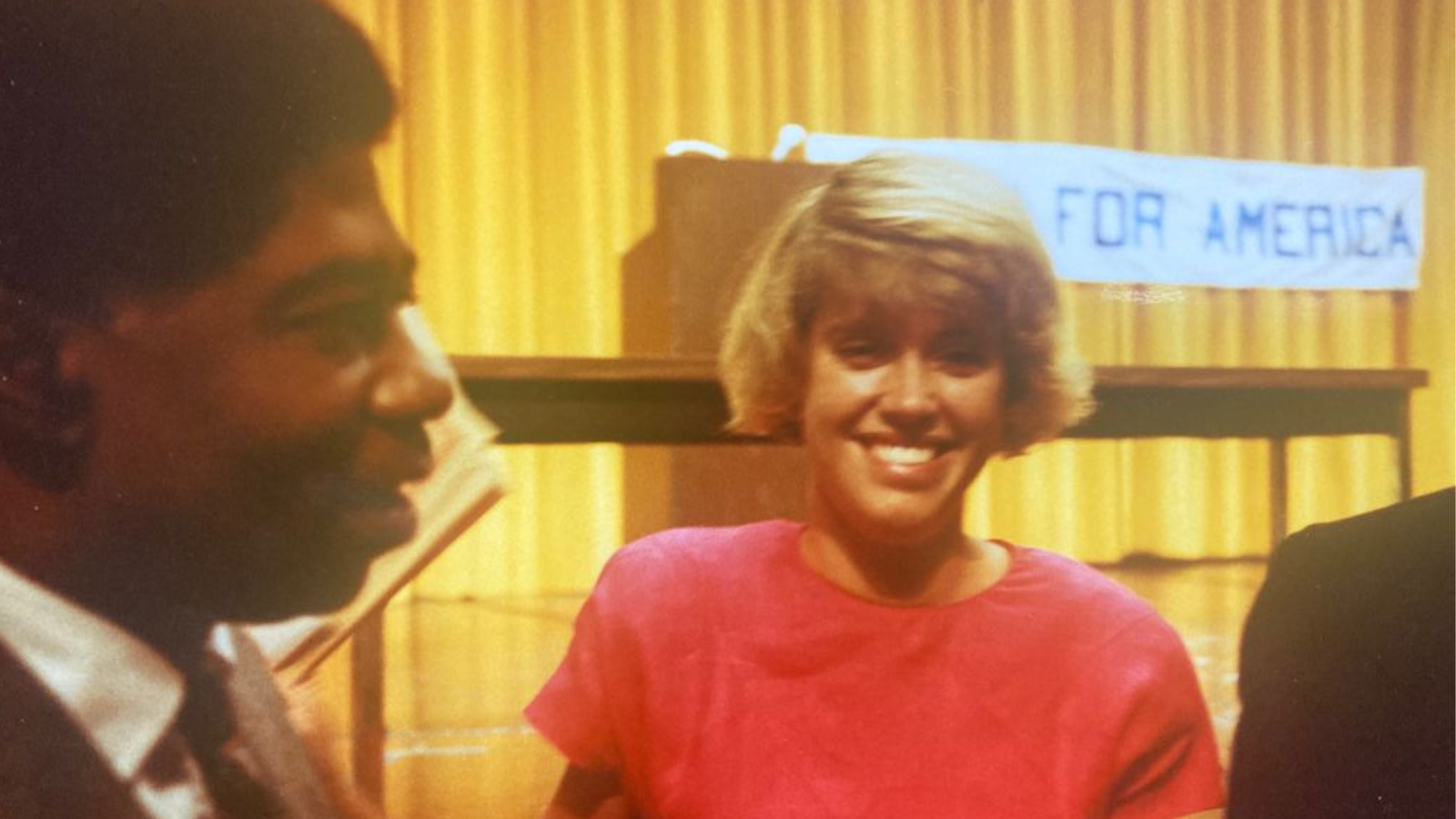
Me at the first Teach For America summer institute with acclaimed education professor Dr. Carl Grant.
Thirty-five years ago, people doubted that young people would commit themselves to this work. The young people proved them wrong, and they’re still doing so, with 100,000 more expected to join this effort in the next decade around the world. We need their naivete, their idealism, their energy, just as we need the hard-earned wisdom of those who have been at this for decades.
That’s what we’re committed to at Teach For All—growing collective leadership everywhere, and fostering learning among the educators who are reshaping education in their countries through our Global Institute for Shaping a Better Future. Through the Better Future Hub , educators and leaders everywhere can join free courses, workshops, and communities to learn alongside one another. We’d love for you to join us.
The first question for all of us is the one Larisa put to communities across Armenia—what do we want to be true for our countries and our global society? And then—are we doing all we can to develop the leadership and foster the relationships and the learning among them that it will take to develop young people who can get us there? If we commit to this work together and stay with it, we’ll have given our next generation what it needs to shape a better world for all of us.
Comments (0)
Popular

Dive in
Related
Video
Students Leading the Way: Transforming Communities Through Project-Based Education
By Nicole Ames Chipana • Apr 22nd, 2026 • Views 22
Blog
What Kind of Leadership Will it Take to Transform Education?
By Radha Ruparell • Apr 22nd, 2026 • Views 20
Video
Students Leading the Way: Transforming Communities Through Project-Based Education
By Nicole Ames Chipana • Apr 22nd, 2026 • Views 22
Blog
What Kind of Leadership Will it Take to Transform Education?
By Radha Ruparell • Apr 22nd, 2026 • Views 20